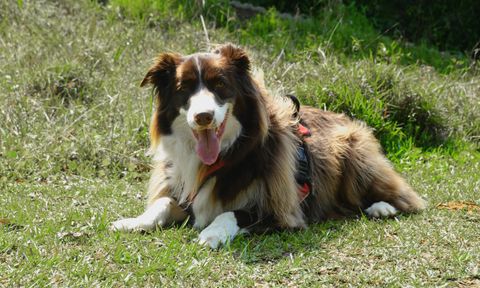
Australian Shepherds and Border Collies get confused for each other constantly, and it's easy to see why: both are medium-sized, high-drive herding dogs, often merle-coated, bred to think independently and move livestock all day. But they're genuinely different dogs underneath the resemblance, with different intensity levels, different histories, and — this matters more than most buyers expect — different tolerance for a life that isn't built entirely around a job for them to do.
Origins and Purpose
Despite the name, the Australian Shepherd was developed in the United States, not Australia — the breed took shape in California in the 19th century from Spanish-heritage sheepdogs, with a name that most likely traces to association with Basque shepherds who arrived via Australia in the 1800s rather than any Australian origin of the dogs themselves. The breed's popularity took off in the mid-20th century through rodeo and horse-show demonstrations, and it remains deeply tied to American ranch and rodeo culture as an all-purpose stock and companion dog. The United States Australian Shepherd Association notes the AKC recognized the breed on September 1, 1991, and placed it in the Herding Group in 1993.
The Border Collie's history runs in almost the opposite geographic direction: it's a British breed, developed along the England–Scotland border area specifically for herding sheep on foot over open, hilly terrain, with the name "Border Collie" first used in 1915 to separate working stock dogs from the increasingly show-oriented "collie" type. The AKC recognized the Border Collie considerably later, in 1995, after decades in which working breeders actively resisted AKC recognition out of concern that show-ring breeding would prioritize looks over herding ability — a tension that still shapes how the working Border Collie community talks about the breed today.
Temperament: Two Different Kinds of "High Drive"
Both breeds are frequently cited among the most intelligent dog breeds, and both were bred for a job that requires independent decision-making, not just obedience — but the way that shows up day to day differs. Australian Shepherds are typically described as loyal, playful, and protective, often forming a strong bond with one household while remaining reserved with strangers; they retain real herding instinct, which commonly shows up as attempts to herd children, other pets, or joggers by nipping at heels — manageable with training, but worth knowing about in advance.
Border Collies are, by most working and breed-club accounts, even more singularly intense: bred for a "strong eye" and quiet, focused control of livestock at a distance from the handler, they tend to fixate — on a ball, a herding task, a repetitive movement — with an intensity that can tip into obsessive behavior (shadow-chasing, compulsive fetching, reactivity to movement) if the dog doesn't have a legitimate outlet for it. Both breeds are famous, not always fondly, for how much trouble a bored, under-worked dog can get into; this is arguably the single most important shared trait to plan around, more than any difference between them.
Quick Specs Compared
| Trait | Australian Shepherd | Border Collie |
|---|---|---|
| Height | Males 20–23 in · Females 18–21 in | Males 19–24 in · Females 18–22 in |
| Weight | 35–70 lb | Males ~31–55 lb · Females ~26–42 lb |
| Life expectancy | Roughly 12–14 years (a 2024 UK study found a median around 13.7 years) | Roughly 12–13 years (recent UK studies found 12.1–13.1 years) |
| AKC group | Herding Group (since 1993) | Herding Group (since 1995) |
| Energy level | Very high — needs a job or serious daily outlet | Very high, often described as the most work-driven of common breeds |
| Coat & grooming | Medium double coat, moderate–heavy seasonal shedding | Medium double coat (rough or smooth), moderate–heavy seasonal shedding |
| Family/apartment fit | Good family dog with structure; poor fit for apartments without major daily exercise | Best with an active, space-rich household or serious dog-sport commitment; a difficult apartment fit |
| Approx. purchase price (US) | $800–$1,800 from a breeder | $600–$1,200 typical, show/sport lines higher |
Health Considerations
This section describes breed-level tendencies, not a diagnosis for any individual dog. A veterinarian is the only reliable source for evaluating a specific dog's health or eye/DNA test results. See our veterinary disclaimer for more on the limits of general breed information.
Both breeds carry the merle coat gene, which is responsible for their mottled coloring and blue or partially blue eyes in many individuals — and both carry the well-documented risk that comes with it: breeding two merle-patterned parents together ("double merle") significantly raises the odds of puppies born deaf, blind, or both, due to how the gene affects pigment-related development in the eyes and ears. This is a breeding-practice risk rather than an individual-dog risk, but it's a legitimate reason to ask a breeder directly whether either parent is merle and, if so, to confirm the other parent isn't.
Australian Shepherds carry the MDR1 gene mutation at meaningfully elevated frequency, which causes increased sensitivity to certain common drugs — including ivermectin (found in some heartworm preventatives) and several anesthetics and anti-diarrheal medications — at doses that are normally safe for other dogs. A DNA test for the mutation exists and is worth doing before your Aussie is prescribed anything in the affected drug classes; the same mutation appears in several other herding breeds, including some Collie lines. Hip dysplasia is a real but comparatively lower-frequency concern in Australian Shepherds — commonly cited around 6% in breed data — and hereditary cataracts and other inherited eye conditions are among the more commonly reported concerns by owners.
Border Collies are most closely associated with Collie eye anomaly (CEA), an inherited, congenital condition affecting the development of the eye that ranges from mild and unnoticeable to serious vision impairment — a DNA and ophthalmologic test exists, and reputable breeders screen for it. Hip dysplasia is also a concern breeders commonly test for via OFA or equivalent hip screening, and epilepsy appears in the breed, though solid breed-wide prevalence figures for epilepsy specifically weren't found in the primary sources checked for this guide, so it's presented here as a documented tendency rather than a specific statistic.
Cost Comparison
Purchase prices are broadly similar and both modest compared to some other purebreds: Australian Shepherd puppies from a breeder in the U.S. typically run $800–$1,800, while Border Collies typically run somewhat lower at $600–$1,200 from pet-line breeders, with working- or sport-line and show-quality Border Collie puppies sometimes reaching $2,000–$4,000. Annual ownership costs for both breeds land in a fairly wide range depending heavily on activity-related spending (dog sports, professional training, higher food needs for a very active dog) — commonly cited estimates run roughly $960–$1,800 a year for an Australian Shepherd and $1,500–$6,000 for a Border Collie, with the wider Border Collie range reflecting how much some owners invest in agility, flyball, or herding-trial participation. For either breed, our cost-of-owning-a-dog guide and, given the inherited conditions above, our guide to pet insurance for genetic conditions by breed are worth reading before you commit.
Which One Fits Your Life?
If you want a dog that's intensely loyal to its own family, more socially reserved with strangers, and happy to combine serious exercise with genuine downtime once its needs are met, an Australian Shepherd tends to be the more forgiving choice of the two for an active family household — including one with kids, provided the herding-nip instinct gets managed early. If you want (or already do) a dog sport at a competitive level — agility, flyball, or actual sheep herding — and can offer near-daily structured mental and physical work, a Border Collie is often considered the more singularly capable working partner of the two, but it's also the harder breed to keep happy as "just" a pet in a lower-activity household; without a real outlet, that intensity turns inward as obsessive or anxious behavior more readily than it does in most Australian Shepherds.
Neither breed is a good fit for a household that can't offer substantial daily exercise and mental engagement — that's true of both, not a differentiator between them. If you're drawn to this comparison because you want a smart, biddable working dog but aren't sure a herding breed's intensity is for you, our sister comparison of Labrador Retriever vs. Golden Retriever covers two lower-drive sporting breeds with a gentler day-to-day temperament. If a structured, protective working dog appeals to you more than a herding one, our German Shepherd breed guide is worth reading, and our guide to choosing a reputable dog breeder covers the health-testing questions — including MDR1 and CEA screening — worth asking before you commit to either breed.
Sources
- United States Australian Shepherd Association — The Australian Shepherd (history and AKC recognition)
- American Kennel Club — List of Breeds by Group
- Wikipedia — Australian Shepherd (size standards, MDR1, and health-issue overview, cross-checked against USASA/AKC)
- Wikipedia — Border Collie (history, size standards, and health-issue overview, cross-checked against AKC)
- Hepper — How Much Does an Australian Shepherd Cost?
- Hepper — How Much Does a Border Collie Cost?
Sources verified during editorial review, September 2026. Prices and availability can change.