A note on how this guide was built: TrundlePaw has not physically tested the feeders and fountains below. This is a research-based comparison built from each manufacturer's published specifications — capacity, materials, filtration method, power source, and list price — cross-checked against the same product page on a major retailer where the manufacturer's own page was incomplete. Where a spec wasn't publicly confirmed, that's noted rather than estimated.
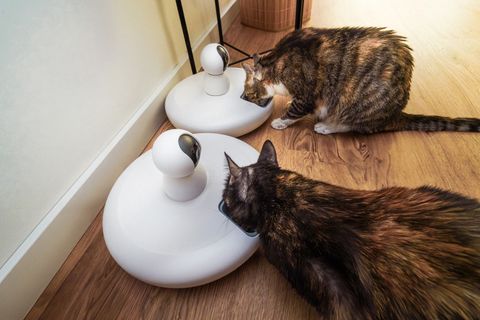
Two Different Purchases, Often Bought Together
"Automatic pet feeder" and "pet water fountain" get lumped into the same shopping list, but they solve unrelated problems. A feeder dispenses a measured amount of food on a schedule, which matters for portion control, multi-pet households where one animal eats faster than another, or owners who aren't home at a consistent time every day. A fountain keeps water moving, which some cats and dogs will drink from more readily than a static bowl — a meaningful detail for cats in particular, since feline lower urinary tract health is closely tied to water intake, and cats as a species evolved with much of their fluid coming from prey rather than open water sources. Neither device is a substitute for actually watching how much your pet eats and drinks; both just make the process more consistent. If you're assembling first-time gear for a new dog, our essential gear for a new puppy checklist covers where feeders and fountains fit alongside everything else on the list.
What to Look For in an Automatic Feeder
The spec sheet differences that actually affect day-to-day use: hopper capacity (how many days you can go between refills), portion granularity (can it dispense 1/8 cup or only whole cups — relevant if your dog or cat is on a strict portion for weight management), power backup (a feeder that goes silent during a power outage defeats the purpose if you're relying on it while away), and whether the bowl and hopper are dishwasher-safe stainless steel or a plastic that can hold odor and scratch over time, which matters more for cats — plastic bowls are a common contributor to feline chin acne. If your pet is already being managed on a specific portion because of weight, our guide to how to tell if your dog or cat is overweight is a useful companion piece before you lock in a feeding schedule on any device.
What to Look For in a Water Fountain
Fountains vary mainly in filtration, capacity, and material. A carbon filter reduces odor and some chlorine taste and needs periodic replacement (typically every 2–4 weeks with regular use, per most manufacturers); a multi-stage filter adds mesh pre-filtration and sometimes an ion-exchange resin stage for softer water. Capacity determines refill frequency — larger households or multi-cat homes will drain a small reservoir daily. Plastic fountains are lighter and cheaper but can develop scratches that trap bacteria over time; stainless steel and ceramic options exist at a higher price point and resist that wear better, though none of the models compared below use those materials. Whatever fountain you choose, the pump and reservoir need regular cleaning — a fountain that isn't cleaned on schedule can grow biofilm faster than a bowl that gets washed daily, which works against the reason you bought it.
Automatic Feeders Compared
| Product | Type / Mechanism | Materials | Capacity | List Price (US) | Best For |
|---|---|---|---|---|---|
| PetSafe Smart Feed (2nd Gen) | Wi-Fi programmable feeder, up to 12 meals/day, 1/8–4 cup portions | Stainless steel bowl; plastic hopper and lid, dishwasher-safe | 24 cups (6L) dry/semi-moist food | $134.99 | Owners who want remote scheduling and low/empty alerts via app |
| PETLIBRO Granary (5G WiFi) | App-scheduled feeder, up to 10 meals/day, 1–50 portions per meal (~20ml each) | Stainless steel bowl; sealed plastic housing | 5L (~24 cups) | $89.99 | Budget-conscious owners who still want app control and dual power backup |
Water Fountains Compared
| Product | Type / Mechanism | Materials | Capacity | List Price (US) | Best For |
|---|---|---|---|---|---|
| PetSafe Drinkwell Multi-Tier | Two-tier gravity fountain with free-falling stream, submersible pump | BPA-free plastic; replaceable carbon filter | 100 oz reservoir | $35.99 | Multi-pet homes and senior/arthritic pets (elevated upper bowl) |
| Catit Flower Fountain | Single-basin fountain, 3 adjustable flow settings, triple-action filter | BPA-free plastic | 100 fl oz / 3L | Not listed on manufacturer site; roughly $30–$40 at major retailers | Cats who prefer a gentle, adjustable flow over a single strong stream |
Notes on Each Product
The two feeders take different approaches to the same problem. PetSafe's Smart Feed is the more established option — it's been sold in some form since well before "smart home" pet gear was common — and its portion range (as small as 1/8 cup) makes it a reasonable fit for cats or small dogs on tightly controlled diets. PETLIBRO's Granary undercuts it on price by roughly $45 while matching daily capacity and adding 5GHz Wi-Fi support and dual battery-plus-AC power redundancy, which is worth weighing if outages are a concern where you live. Neither manufacturer publishes independent third-party accuracy testing for portion dispensing, so if gram-level precision matters — for a pet on a prescription weight-loss plan, for example — that's worth raising with your veterinarian rather than assuming any consumer feeder hits its stated portion exactly every time.
On the fountain side, PetSafe's Drinkwell Multi-Tier is the simpler and cheaper mechanism: a two-level design with a steady free-falling stream and no flow adjustment. Its elevated upper bowl is specifically positioned for pets with joint pain, which is a genuine consideration for older cats and dogs — see our senior dog care guide for more on mobility-related accommodations at home. Catit's Flower Fountain costs slightly more for a single-basin design but adds adjustable flow (gentle bubbling versus a stronger stream) and a three-stage filter versus Drinkwell's carbon-only filter — the tradeoff being a smaller and, per its published dimensions, more compact reservoir footprint that some cats' body language researchers suggest may appeal more to cats who are put off by louder or more turbulent water movement, though that preference is genuinely individual and neither manufacturer nor TrundlePaw can promise a specific cat will prefer either design.
How to Choose Between Them
Start with the animal, not the gadget. A cat with any history of urinary issues benefits more from a fountain that actually gets used — which sometimes means trying the cheaper option first, since a fountain a cat ignores provides zero benefit regardless of its filtration stages. A multi-pet household leans toward a feeder with a larger hopper and, if pets eat at very different speeds, a model compatible with a meal-splitter or multiple stations rather than one bowl. A single indoor cat on a vet-recommended weight-loss plan benefits most from precise, small portion increments and consistent timing — the app-based scheduling on either feeder above is the relevant feature there, more than raw hopper capacity. If you're also researching litter box setup as part of new-cat gear, our guide to the best cat litter for odor control covers a parallel decision in the same "gear that runs itself" category.
Multi-Pet Households and Feeding Order
A single automatic feeder solves scheduling for a single-pet household cleanly, but multi-pet homes need a bit more planning. Neither the PetSafe Smart Feed nor the PETLIBRO Granary can physically stop a faster-eating pet from finishing their own portion and then walking over to finish a slower housemate's, since both are stationary, open-bowl designs rather than microchip- or RFID-gated feeders that only open for one recognized pet. If food-guarding, resource competition, or one pet consistently overeating at another's expense is already a pattern in your household, that's a reason to look specifically at a selective, chip-reading feeder designed to solve that exact problem, rather than assuming any programmable feeder from this comparison will manage it — none of the four products above are built for that use case. For households without that specific issue, PetSafe's optional Meal Splitter accessory is the more modest, lower-cost way to divide a single dispensed portion into two bowls at feeding time, which helps with simultaneous feeding even if it doesn't prevent one pet from finishing early and moving to the other bowl.
Cleaning and Filter Maintenance Schedules
Both fountains in this comparison rely on filtration that degrades with use, not gear that runs indefinitely once installed. PetSafe's carbon filter for the Drinkwell Multi-Tier is designed to be replaced on a recurring basis — sold in 3-packs specifically because a single filter isn't meant to last the life of the fountain — and the pump itself needs periodic hand-washing since it isn't listed as dishwasher-safe, unlike the bowl. Catit's triple-action filter combines mesh, activated carbon, and ion-exchange resin stages in one cartridge, which simplifies replacement to a single part but doesn't reduce how often it needs changing. On the feeder side, both the Smart Feed and Granary bowls are described as dishwasher-safe, but the hopper and internal auger mechanism that moves food through the unit are not — those need periodic hand-cleaning to prevent oil residue from fatty kibble building up and potentially jamming the dispensing mechanism over time, a maintenance step that's easy to overlook precisely because the device is marketed as "automatic."
What Matters Beyond the Product Itself
No feeder replaces knowing your pet's actual daily calorie needs — our guide on how much to feed your cat and the equivalent portion guidance for dogs are worth reading before you program any device, since a feeder will faithfully dispense an incorrect portion just as reliably as a correct one. Fountains and feeders also both need real maintenance: filters replaced on schedule, hoppers emptied and washed rather than just topped up indefinitely, and pumps cleaned of the mineral buildup that accumulates with hard tap water. None of that is optional just because the device is labeled "automatic." And if your dog or cat has an existing diagnosed health condition affecting eating or drinking — increased thirst, sudden appetite changes, reluctance to eat — that's a reason to talk to your veterinarian rather than assume new gear will resolve it; automated feeding and watering devices manage routine, not medical conditions.
Sources
- PetSafe — Smart Feed Automatic Dog and Cat Feeder, 2nd Generation
- PETLIBRO — Granary Automatic Cat Feeder with WiFi App Control
- PetSafe — Drinkwell Multi-Tier Pet Fountain
- Catit — Flower Fountain product page
Sources verified during editorial review, September 2026. Prices and availability can change — check the manufacturer or retailer page for current pricing before purchasing.