Few cat breeds are as instantly recognizable, or as vocal about their opinions, as the Siamese. One of the founding breeds of the modern cat fancy, it's known for a striking color-point coat, near-constant conversation, and an attachment to its people that borders on dog-like. Here's what the breed is actually like to live with, the health conditions it's genuinely predisposed to, and what one costs to buy and keep.
Temperament
The CFA's own breed standard describes Siamese temperament as "vocal, affectionate, active; can be insistent," and calls it a breed "unsurpassed by any other" in its ability to communicate with humans — anyone who's lived with a Siamese will recognize that as understatement. These cats are intensely people-oriented, often bonding to one person in particular, following their owners from room to room, and reliably making their opinions about mealtimes, attention, and closed doors known in a loud, distinctive voice. They're also considered among the more intelligent cat breeds and tend to be quick to learn routines, including ones their owners didn't intend to teach them.
That devotion has a cost: Siamese cats generally don't do well left alone for long stretches and can develop stress-related behaviors, including excessive vocalization or over-grooming, in under-stimulated or under-socialized situations. They tend to get along well with other pets and children in an active household, provided they're not the only source of company for long hours at a time.
History and Origin
The Siamese descends from a landrace of pointed cats native to Thailand (historically Siam), documented in Thai manuscripts dating back centuries, including poetry from the Ayutthaya period (1350–1767). The first Siamese cat in the U.S. is generally said to have been a gift to President Rutherford B. Hayes in 1878, and British imports beginning in 1884 helped establish the breed in the West. The Siamese was one of the founding breeds recognized when the CFA itself was established in 1906. Breeding preferences shifted from the 1950s onward toward the leaner, more angular "modern" Siamese most people picture today, which eventually led to a formal split between the modern Siamese and the more moderately built traditional Thai cat, now registered separately by some associations.
Quick Specs
| Trait | Siamese |
|---|---|
| Size | Medium, svelte and long-bodied; males proportionately larger per the CFA standard |
| Weight | CFA's standard sets no fixed weight; commonly reported in the roughly 6–14 lb range |
| Life expectancy | A 2024 UK veterinary study found about 11.7 years, in line with cats generally |
| Registries | CFA founding breed (1906); also TICA, and other registries |
| Energy level | High; active and playful, needs engagement, not just space |
| Coat & grooming | Short, fine, close-lying coat; low grooming needs, occasional brushing |
| Apartment fit | Very good, provided the cat isn't left alone for long stretches |
| Approx. purchase price (US) | Roughly $450–$1,100 from a reputable breeder |
Color Points and Body Types
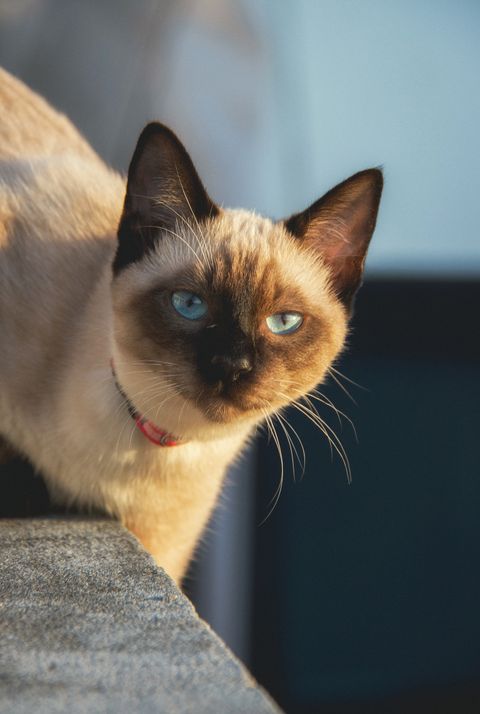
CFA's Siamese standard officially recognizes only four color points — seal, chocolate, blue, and lilac — each pairing a lighter body with a darker mask, ears, legs, feet, and tail, alongside the breed's signature deep blue eyes. Cats with the same body type but other point colors (red, cream, tortie, lynx/tabby points, and more) are registered by CFA as a separate breed, the Colorpoint Shorthair, even though many owners and other registries simply call them Siamese. It's worth asking a breeder which registry standard a kitten is being sold under if a specific color matters to you.
Body type is the other place "Siamese" gets used loosely. The lean, extremely angular, wedge-headed cat most people picture today is a mid-20th-century refinement; the more moderately built, rounder-headed cat that was standard before that shift is now preserved separately by some registries (including TICA) as the Thai breed. Both are legitimately descended from the same Wichianmat landrace of Thailand, and neither is more "authentic" than the other — they simply represent a breeding-standard split that happened in the 1980s, so it's reasonable to ask a breeder directly which body type their cats are bred toward if you have a preference.
Health and Lifespan
This section describes breed-level risk, not a diagnosis for any individual cat. Only a veterinarian, often with bloodwork or imaging, can determine whether any of this applies to a specific Siamese. See our veterinary disclaimer for more on what general breed information can and can't tell you.
Amyloidosis is the condition most specifically associated with this breed. It's a disease in which an abnormal protein builds up in organ tissue — in Siamese cats, primarily the liver, with the kidneys, stomach, intestines, thyroid, and heart affected to a lesser extent — and it's progressive and currently untreatable, ultimately leading to organ failure. A multi-year veterinary study found amyloidosis diagnosed in 6.2% of Siamese cats seen at a referral hospital, compared to roughly 1.2% of cats overall in the same dataset, with most affected cats developing signs between 1 and 5 years of age (average around 3.5 years). Progression varies a great deal — some cats maintain adequate organ function for years, while others develop liver failure within twelve months of diagnosis — and there's currently no way to predict which course an individual cat will follow.
Chronic bronchial disease (a lower-airway condition similar in some ways to asthma in humans, causing coughing, wheezing, and reduced exercise tolerance) is widely described in veterinary literature as more common in Siamese cats than in cats generally, though — worth being upfront about — no organization has published a solid breed-wide prevalence percentage, and at least one Australian study didn't find a clear breed effect; the consensus leans toward a genuine predisposition, but the exact numbers aren't settled. The same underlying genetics that produce the breed's signature color-point pattern and blue eyes is also linked to abnormal neurological wiring between the eye and brain, which historically produced the crossed-eyed look early Siamese were known for (now largely bred out) and which contributes to the breed's documented predisposition toward progressive retinal atrophy, a hereditary and currently untreatable cause of vision loss.
Beyond these breed-specific issues, Swedish insurance-claims data has found Siamese cats show a higher overall rate of illness claims than average, with cancer — particularly mammary tumors in unspayed females — as a leading cause of death, which is itself one more reason spaying is commonly recommended well before a cat's first heat. On the positive side, the same data found Siamese cats at somewhat lower risk of feline lower urinary tract disease than cats generally.
Cost of a Siamese Cat
Siamese kittens are comparatively affordable as purebred cats go — typically $450–$1,100 from a reputable breeder in the U.S., well below the price of a Bengal or Maine Coon. Ongoing costs are modest for a generally healthy breed, commonly landing around $300–$660 a year for food, litter, and routine preventative care, though — as with the Bengal's cardiac risk — the amyloidosis risk above is a real argument for pet insurance or a dedicated savings buffer, since the condition's monitoring and management costs can be substantial and unpredictable once symptoms begin. Our guide to pet insurance for genetic conditions by breed is worth reading before you commit to a Siamese kitten.
Grooming and Exercise Needs
Grooming is minimal — the short, fine coat sheds relatively little and needs only occasional brushing to stay glossy, and dental care follows the same general routine any cat needs rather than anything breed-specific. The bigger daily commitment with this breed is social and mental: Siamese cats need real interaction, not just a comfortable place to sleep, and do best in households where someone is home for meaningful parts of the day or where a second pet can provide company. Interactive toys, climbing space, and training (many Siamese take well to leash-walking or simple tricks) help channel the breed's intelligence and activity level productively, and a Siamese kitten introduced to a harness and carrier early tends to adapt to both far more readily as an adult than one that meets either for the first time at a stressful moment, like an emergency vet visit.
Living With a Vocal Cat
The Siamese's conversational streak is worth planning around rather than being surprised by. This is a breed that will comment — often loudly and repeatedly — on an empty food bowl, a closed door, or simply not having your attention in the last few minutes, and the voice itself is more nasal and insistent than a typical cat's meow. Some owners find this endearing and describe genuinely feeling "talked to"; others find it wearing, especially overnight or in shared-wall housing, and it's a reasonable thing to weigh honestly rather than assume you'll adjust to. Consistent responses (not reinforcing demanding vocalization with attention every single time, while still meeting the cat's real social needs) tend to help more than trying to train the vocalization away entirely, which is unlikely to fully succeed given how central it is to the breed.
Is a Siamese Right for You?
A Siamese suits an owner who wants a highly interactive, vocal, dog-like cat and is prepared to be talked to, followed around, and included in daily life — this is not a breed that thrives ignored in a back room. It's a reasonable fit for apartments given its modest space needs, provided it isn't left alone for very long stretches, and its relatively affordable purchase price makes it accessible compared to some other pedigreed breeds, though the amyloidosis risk is worth budgeting and watching for over the cat's lifetime.
If you like the breed's vocal, people-oriented nature but want a different health profile and a much bigger, calmer cat, our Maine Coon breed guide and Ragdoll breed guide are worth comparing, and our Bengal breed guide covers another highly active, people-focused breed with its own distinct genetic risks. Whichever breed you choose, our guide to choosing a reputable cat breeder covers the health-testing questions worth asking before you put down a deposit.
Sources
- Cat Fanciers' Association (CFA) — Siamese breed standard
- Universities Federation for Animal Welfare (UFAW) — Siamese: Amyloidosis
- UFAW — Siamese: Chronic Bronchial Disease
- Wikipedia — Siamese cat (longevity study and Swedish insurance-data citations, cross-checked against CFA/UFAW)
Sources verified during editorial review, September 2026. Prices and availability can change.