The Bengal is, quite literally, part wildcat by design — a breed built by crossing domestic cats with the Asian leopard cat, and it shows in a build and energy level that's unlike most household cats. It's currently one of the most popular breeds in TICA's registry. Here's what that heritage actually means day to day, the heart and eye conditions worth knowing about, and what a Bengal costs to buy and keep.
Temperament
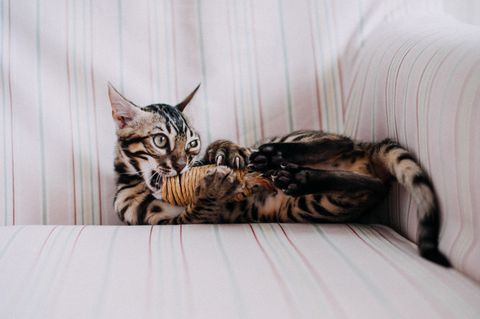
Bengals are athletic, inquisitive, and famously high-energy — TICA's own breed materials describe them as "inquisitive, spirited, loving," and most owners will tell you the "spirited" part is not a euphemism. This is a breed built to climb, jump, and explore, and many Bengals genuinely enjoy water, which is unusual among cats and often shows up as an interest in dripping faucets, fish tanks, or even joining a shower. They're highly intelligent and trainable — leash-walking and clicker training are realistic goals with this breed in a way they aren't with most cats — and they tend to be very people-oriented, often following their owners from room to room, even if they're not always classic laptop cats content to sit still for long stretches.
The flip side of that intelligence and energy is that a bored Bengal is a genuinely destructive one. Without daily interactive play, climbing structures, and mental enrichment, Bengals are prone to nighttime zoomies, counter-surfing, and general trouble-seeking well beyond what's typical for a cat.
History and Origin
The breed's foundation dates to 1963, when California breeder Jean Mill crossed a domestic cat with an Asian leopard cat — a small wild cat native to Asia weighing roughly 5–12 lb — though the modern breed traces more directly to Mill's breeding program beginning in the early 1980s. The International Cat Association (TICA) accepted the Bengal as a new breed in 1986 and granted it championship status in 1991; the Cat Fanciers' Association (CFA) followed much later, accepting the breed in 2016 under its Miscellaneous class, with a requirement that registerable cats be at least six generations removed from any Asian leopard cat or non-Bengal domestic ancestor (denoted "F6" or later) — a rule meant to ensure the cats being shown and bred are behaviorally and physically domestic despite the wild ancestry in the breed's origin.
That generational math also matters legally. Cats closer to the wild ancestor — generally F1 through F4, with more direct leopard-cat parentage — are treated in some U.S. jurisdictions as exotic or hybrid animals rather than ordinary domestic cats, and a handful of places restrict or ban them outright: Hawaii bans Bengal cats of any generation, citing risk to native wildlife, and New York City restricts the breed under its exotic-animal rules. The pet-quality kittens sold by most Bengal breeders today are typically F4 or later generations, which TICA and most state and local laws treat as fully domestic — but if you're considering a Bengal, it's worth confirming your specific city and state's current rules before you commit, since they vary by jurisdiction and do change.
Quick Specs
| Trait | Bengal |
|---|---|
| Size | Medium–large; full size reached around 2 years old |
| Weight | Females ~6–12 lb · Males ~9–15 lb |
| Life expectancy | TICA cites 12–20 years with good care; a 2024 UK veterinary study of insured/vet-record cats found a shorter median around 8.5 years — the two figures reflect different populations, not a contradiction to resolve with one number |
| Registries | TICA (1986/1991), CFA (2016, Miscellaneous) |
| Energy level | Very high; needs daily active play and climbing space |
| Coat & grooming | Short, dense, low-maintenance pelt-like coat; occasional brushing |
| Apartment fit | Workable only with a cat tree, window perches, and real daily play |
| Approx. purchase price (US) | $1,500–$3,000 from a health-tested breeder |
Coat Patterns and Colors
The Bengal's coat is the breed's headline feature, and it comes in two main patterns: spotted, with distinct rosettes similar in concept (though not scale) to a real leopard's, and marbled, a swirled, more horizontally-flowing pattern. TICA's breed literature notes the brown/black tabby coloring is the most popular, alongside "snow" variants (lighter, colder-toned coats from Siamese ancestry further back in the breed's development) and silver. Some Bengals also carry a "glitter" gene that gives individual hairs an iridescent sheen in direct light — a cosmetic trait, not a health indicator, but one that shows up often in breeder marketing and is worth knowing isn't a sign of anything beyond coat genetics.
Health and Lifespan
This section describes breed-level risk, not a diagnosis for any individual cat. Only a veterinarian — often with an echocardiogram or genetic test in hand — can tell you whether a specific Bengal is affected. See our veterinary disclaimer for more on the limits of general breed information.
Hypertrophic cardiomyopathy (HCM) — a thickening of the heart muscle that's the most common heart disease in cats generally, and one that can cause sudden heart failure or clot-related complications with no obvious warning signs beforehand — is the single biggest health concern TICA flags for the breed. A 2013 study specifically screening Bengals found a prevalence around 16.7%, and no genetic test for the mutation(s) responsible currently exists (as of the most recent published guidance), which is why TICA recommends annual echocardiogram screening by a board-certified veterinary cardiologist for any Bengal used for breeding, and why it's a reasonable question to ask about a kitten's parents even if you're buying purely as a pet.
Progressive retinal atrophy (a Bengal-specific form, sometimes called PRA-b) is the other major concern: it's an inherited, incurable condition that begins causing vision loss around 7 weeks of age and typically results in full blindness by around 2 years old. Because it's a recessive condition with a known genetic marker, a DNA test exists and responsible breeders test breeding cats to avoid producing affected kittens — it's worth asking directly whether a kitten's parents have been tested clear.
Two other conditions specific to the breed's genetics are worth knowing: pyruvate kinase (PK) deficiency, a red-blood-cell disorder that breeders test for before breeding, and Bengal ulcerative nasal dermatitis, a hereditary, incurable but manageable skin condition affecting the nose, first documented in the breed in 2004 and generally controlled with topical treatment rather than cured. None of these conditions are unique to Bengals in kind, but the combination of a relatively young breed, a documented cardiac risk, and a breed-specific eye disease makes health-testing documentation from a breeder more important here than with longer-established, more genetically diverse cat breeds.
Cost of a Bengal Cat
A Bengal kitten from a reputable, health-tested breeder in the U.S. typically runs $1,500–$3,000, with an average often cited around $2,000 — pricing tends to track coat pattern and coloring (marbled and certain "snow" colorations often price at a premium) as much as pedigree. Ongoing costs are relatively modest for a healthy adult Bengal: routine food, litter, and preventative care commonly run in the range of $600–$2,400 a year depending on food quality and whether you carry pet insurance, though the wide range in published estimates reflects how much a single cardiac workup or emergency visit can shift the total — which is exactly the scenario pet insurance for genetic and congenital conditions is meant to help with. Our guide to pet insurance for genetic conditions by breed and general primer on whether pet insurance is worth it are both worth reading before you commit to a Bengal kitten, ideally before you'd need to disclose a pre-existing condition.
Grooming and Exercise Needs
Grooming is minimal — the Bengal's short, dense, pelt-like coat sheds relatively little and needs only occasional brushing, and the breed's fondness for water sometimes makes bathing easier than with a typical cat, though it's rarely necessary. The real daily commitment is exercise and enrichment: this breed needs active, interactive play — wand toys, puzzle feeders, and vertical space like cat trees or shelving — well beyond what most household cats require, and a Bengal that doesn't get it will find its own outlets, usually ones you'd rather it didn't. Rotating toys and varying play sessions matters more with this breed than with a lower-energy cat, since Bengals are quick to lose interest in anything that stays the same for too long.
Living With a Bengal
Because Bengals are unusually strong jumpers and climbers even by cat standards, most owners find that securing breakable items on high shelves and investing in a genuinely tall cat tree (rather than treating one as optional) heads off a lot of the counter-surfing and knocking-things-over behavior the breed is known for. The same athleticism and curiosity that makes Bengals engaging companions also makes them more escape-prone than an average house cat if a door or window screen is left insecure, so many owners either keep Bengals strictly indoors with supervised outdoor time (a leash and harness, or a secure "catio" enclosure) or invest early in reliable recall-style training, which — unusually for a cat — many Bengals are genuinely capable of learning.
Is a Bengal Right for You?
A Bengal suits an owner who wants a highly active, dog-like, trainable cat and is genuinely prepared to provide daily structured play and climbing space — not a household looking for a quiet lap cat. It's also a breed where budgeting for cardiac screening and pet insurance from kittenhood is a reasonable precaution given the documented HCM risk, rather than an afterthought.
If you like the athletic, striking-coat appeal of a Bengal but want a calmer, more traditionally affectionate temperament, our Maine Coon breed guide and Ragdoll breed guide cover two much lower-energy large-breed alternatives, and our Siamese breed guide covers another vocal, people-oriented breed with a very different health profile. Whichever breed you choose, our guide to choosing a reputable cat breeder covers the health-testing questions — including HCM and PRA screening for Bengals specifically — worth asking before you put down a deposit.
Sources
- The International Cat Association (TICA) — Bengal breed page
- TICA — Bengal Breed Introduction (PDF)
- Wikipedia — Bengal cat (health-condition citations and CFA recognition details, cross-checked against TICA)
- Hepper — Why Are Bengal Cats Illegal in Some States and Countries?
Sources verified during editorial review, September 2026. Prices and availability can change.