A German Shepherd is one of the most capable, trainable dogs you can bring into a home — and one of the most demanding, in exercise, structure, and the handful of inherited health conditions worth understanding before a puppy or an adult rescue comes home. This guide covers what the breed is actually like day to day, what it tends to cost to buy and keep one in the U.S., and the conditions the breed's own health-screening organizations track most closely.
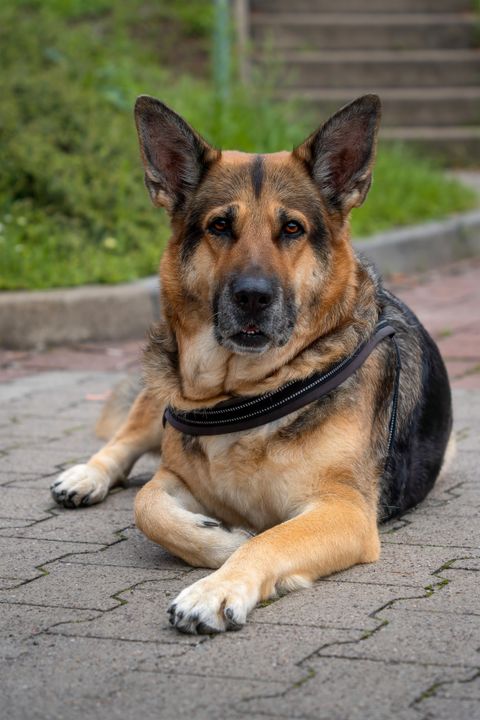
Temperament
The American Kennel Club's official breed standard describes the German Shepherd Dog's temperament as marked by "direct and fearless, but not hostile" confidence, and calls out shyness or nervousness as a serious fault — this is meant to be a poised, self-assured working dog, not an anxious or reactive one. In practice, that translates into a dog that is loyal and watchful with its own family and reserved, rather than instantly friendly, with strangers.
German Shepherds were built to work, and that shows in daily life: they're consistently ranked among the most trainable breeds, which is exactly why they dominate police, military, search-and-rescue, and guide-dog work. The flip side is that a German Shepherd without a job — structured training, a sport, or a genuine daily task — will often invent one, and it's rarely one you'd have chosen, from destructive chewing to obsessive barking at everything that moves outside a window. Line matters here more than in many breeds: dogs from working or protection-sport lines tend to run higher in drive and intensity than dogs bred primarily for the show ring or as companions, so it's worth asking a breeder directly which type your puppy's parents represent.
With early, deliberate socialization to people, other dogs, and everyday situations, German Shepherds are typically excellent, protective family dogs, including with children. Without it, their natural wariness of strangers and territorial instinct can tip into problem behavior — a well-documented reason the breed shows up disproportionately in both bite-liability discussions and breed-specific insurance surcharges.
History and Origin
The breed is a relatively recent, deliberate creation. Cavalry officer Max von Stephanitz began standardizing a German herding dog in 1899, aiming for an all-purpose working dog that combined intelligence, physical soundness, and trainability rather than a fixed look. The breed's utility made it a natural fit for military and police work through both World Wars, and its profile in the U.S. was cemented in the 1920s and '30s by the Hollywood fame of Rin Tin Tin. Today it remains one of the AKC's most consistently registered breeds — it ranked #4 in the AKC's 2025 popularity rankings, behind only the French Bulldog, Labrador Retriever, and Golden Retriever — used as widely in professional working roles — police K-9, military, search-and-rescue, service and guide work — as it is as a family companion.
Quick Specs
| Trait | German Shepherd Dog |
|---|---|
| Height (at withers) | Males 24–26 in · Females 22–24 in |
| Weight | Typically 50–90 lb, males on the heavier end |
| Life expectancy | Roughly 9–13 years; recent large UK studies found a mean near 10–11 years |
| AKC group | Herding Group |
| Energy level | High — needs 1–2 hours of exercise and mental work daily |
| Coat & shedding | Medium double coat, heavy seasonal shedding; weekly brushing (more in shedding season) |
| Apartment fit | Workable only with serious daily exercise; a yard and routine are a better match |
| Approx. purchase price (US) | $1,500–$6,000+ depending on line and breeder |
Health and Lifespan
This section describes breed-level risk, not a diagnosis for any individual dog. A predisposition is not a guarantee, and the only way to know whether a specific German Shepherd is affected by any of the conditions below is through veterinary evaluation, imaging, or genetic testing — see our veterinary disclaimer for more on what general breed information like this can and can't tell you.
German Shepherds are one of the breeds most closely tracked by the Orthopedic Foundation for Animals (OFA), the organization that maintains the largest orthopedic health database for U.S. dogs. A 2017 peer-reviewed analysis of OFA's own hip and elbow database — more than a million hip evaluations and 275,000 elbow evaluations spanning 1970–2015, across 60 breeds — used German Shepherds as one of its three highest-volume breeds specifically because of how frequently they're screened, and reported hip dysplasia in roughly 18.9% and elbow dysplasia in roughly 17.8% of the German Shepherds evaluated in that dataset. Because that population skews toward dogs bred by owners who screen in the first place, it isn't a random sample of every German Shepherd in the country — but it's the best large-scale, breed-specific evidence available, and it's a reasonable part of why hip and elbow scoring of both parents is one of the first things to ask a breeder about.
Degenerative myelopathy (DM) is a progressive, incurable spinal cord disease that usually appears in dogs eight years and older, causing gradual hind-limb weakness and, eventually, paralysis — it is not painful in itself, but it is life-limiting. It's linked to a mutation in the SOD1 gene, and a 2014 UK study of German Shepherds referred to a veterinary teaching hospital found the mutation was common in the breed: about 16% of younger dogs in that sample were homozygous for it (carrying two copies) and a further 38% were carriers with one copy. Carrying two copies raises risk substantially but doesn't guarantee a dog will develop clinical DM, and a DNA test for the mutation is available and increasingly used by breeders to avoid pairing two carriers.
German Shepherds are also a deep-chested breed, which puts them among the breeds at elevated risk of gastric dilatation-volvulus (bloat/GDV) — a genuine emergency in which the stomach fills with gas and can twist, cutting off blood flow. A 2020 genetic study of the condition (which drew heavily on German Shepherd cases, nearly 22% of its research cohort) cited a published lifetime bloat risk across large and giant breeds ranging from roughly 4% to as high as 37% depending on the specific study and breed — a wide range that reflects real variation by breed and bloodline rather than one fixed number for German Shepherds specifically. Signs of bloat (a visibly swollen abdomen, unproductive retching, restlessness, or collapse) call for an emergency vet immediately, not a wait-and-see approach; some owners of at-risk large-breed dogs discuss a preventive gastropexy with their vet, typically at the time of spay or neuter.
Other conditions to ask a breeder or vet about include exocrine pancreatic insufficiency, which UK data suggests affects roughly 1% of the breed, and general large-breed concerns like osteoarthritis later in life. None of this makes the breed unusually fragile — it makes health screening in the parents, and pet insurance that covers genetic and orthopedic conditions, more worth budgeting for than with a breed that carries fewer known predispositions.
Cost of a German Shepherd
Purchase price varies enormously by line. Pet- or companion-quality puppies from a health-tested breeder in the U.S. commonly run $1,500–$3,000; show-quality puppies often run $2,500–$5,000; and working-line puppies bred for protection sport, police, or service work can run $3,000–$6,000 or more. Rescue or shelter adoption is far cheaper, typically in the range of $50–$600, and is worth considering — German Shepherds and Shepherd mixes are common in shelters relative to their popularity.
Ongoing costs follow a familiar large-breed pattern: a first year that includes the purchase price, initial vaccinations, spay/neuter, and gear tends to run several thousand dollars in the U.S., and a healthy adult year — food, routine vet care, flea/tick and heartworm prevention, grooming supplies — commonly lands in the $2,000–$5,000 range, before any unplanned veterinary costs. Given the breed's orthopedic and neurological predispositions above, it's worth reading our broader guide to what it actually costs to own a dog alongside whether pet insurance is worth it for your situation, and — because several of this breed's biggest risks are inherited rather than accidental — our guide to how pet insurance handles breed-linked genetic conditions is directly relevant before you buy a policy.
Grooming and Exercise Needs
The German Shepherd's medium-length double coat sheds year-round and heavily during two seasonal "blowouts" a year, when daily brushing for a couple of weeks makes a real difference to how much fur ends up on your furniture. Outside of that, weekly brushing with an undercoat rake is typically enough; the breed doesn't need professional grooming the way a curly- or continuously-growing-coated breed does.
Exercise is the bigger commitment. This is a working breed bred for stamina, and most adults need something in the range of an hour or two of real activity a day — brisk walks, running, structured play, or, ideally, some kind of job: obedience work, agility, nose work, or herding or protection sports where available. A bored, under-exercised German Shepherd is a common source of destructive chewing, excessive barking, and anxiety-driven behavior, so the exercise and mental-stimulation needs matter as much to temperament as they do to physical health.
Is a German Shepherd Right for You?
This breed tends to suit active, hands-on owners who want a dog that can genuinely work alongside them — whether that's structured training, a dog sport, or simply a very consistent daily routine — and who are prepared to socialize a puppy deliberately rather than assume good temperament will happen on its own. It's a poor match for households that can't offer daily exercise and mental engagement, or for first-time owners who aren't ready to commit to ongoing training.
If you're drawn to the breed's intelligence and trainability but want a lower-drive, more laid-back family dog, our Golden Retriever breed guide and Labrador Retriever breed guide are worth reading side by side with this one. If exercise needs are your main concern, our Poodle breed guide and Beagle breed guide cover two very differently sized, differently coated alternatives. And whichever breed you land on, our guide to choosing a reputable dog breeder walks through the health-testing questions worth asking before you put down a deposit.
Sources
- American Kennel Club — Official Standard of the German Shepherd Dog
- American Kennel Club — German Shepherd Dog breed page
- American Kennel Club — List of Breeds by Group
- American Kennel Club — Most Popular Dog Breeds of 2025
- Oberbauer, Keller & Famula (2017), "Long-term genetic selection reduced prevalence of hip and elbow dysplasia in 60 dog breeds," PLOS ONE
- Orthopedic Foundation for Animals (OFA)
- Holder et al. (2014), "A retrospective study of the prevalence of the canine degenerative myelopathy associated SOD1 mutation... in German Shepherd dogs from the UK," Canine Genetics and Epidemiology
- Hendricks et al. (2020), "Identification of Genetic Susceptibility Factors Associated with Canine Gastric Dilatation-Volvulus," Genes
- Embrace Pet Insurance — German Shepherd puppy price and cost-of-ownership guide
Sources verified during editorial review, September 2026. Prices and availability can change.