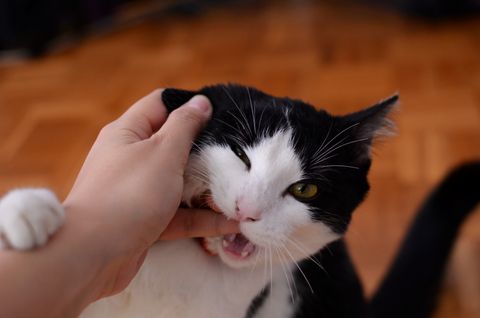
A cat that bites hands, ankles, or arms isn't usually being "mean" — it's almost always one of a few identifiable patterns: play aggression, overstimulation during petting, or redirected arousal at something it can't reach. According to the ASPCA, telling these apart matters, because the fix for a kitten that never learned bite inhibition looks different from the fix for an adult cat that's overstimulated by too much petting.
Veterinary disclaimer. This article is general, informational content. It doesn't diagnose your pet's condition and doesn't replace an in-person veterinary exam. See the full Veterinary Disclaimer.
Why Cats Bite During Play
Cats under about two years old commonly play in ways that look a lot like real predatory behavior: stalking, chasing, pouncing, ambushing, and mock-attacking. The ASPCA notes that kittens normally learn to inhibit the force of their bites through play with littermates — a kitten that bites too hard gets a yelp and the game stops, which teaches restraint over time. Kittens that were orphaned, weaned very early, or raised without littermates sometimes miss that lesson entirely. Letting a kitten play-bite and swat at your bare hands and feet, even gently, reinforces the idea that human skin is a legitimate toy — a habit that gets harder to unwind the longer it continues.
Overstimulation ("Petting-Induced") Aggression
Even affectionate adult cats have a limit on physical contact, and repetitive petting past that point can flip from pleasant to irritating fairly quickly. Warning signs to watch for, according to the Animal Humane Society and the ASPCA, include:
- Tail twitching, lashing, or thumping
- Ears flattening or rotating back
- Skin twitching or rippling along the back
- Dilated pupils or a sudden, fixed stare
- A shift in body position away from you, or tensing up
The practical fix is to stop petting before these signs show up rather than after. If your cat typically tolerates about four minutes of petting before getting irritated, stop at two — shorter, more frequent positive interactions build trust better than pushing to the edge of tolerance every time. Belly rubs are a common trigger even in otherwise relaxed cats, since exposing the belly is a vulnerable position that can flip quickly into a defensive response.
Redirected Aggression
The ASPCA describes redirected aggression as one of the most dangerous forms of cat aggression, precisely because the bite that results is uninhibited — it wasn't aimed at the person or animal it lands on in the first place. It typically happens when a cat becomes highly aroused by something it can see but can't reach or confront, like another cat outside a window, and then bites the nearest available person or pet instead. What makes this pattern easy to miss is the delay: the ASPCA notes there can be hours between the triggering event and the redirected bite. If your cat suddenly seems keyed up, avoid picking it up or crowding it — give it space and time to settle rather than approaching directly.
How to Stop It
- Never use hands or feet as toys. From kittenhood on, redirect all play to wand-style toys or anything that keeps your hands at a distance — this is the single biggest factor in whether a cat learns that human skin is fair game.
- Watch for warning signs and stop before they escalate. Ending a petting session or play bout a little early, before your cat shows the signals above, prevents the bite rather than reacting to it.
- Keep the household consistent. If one person roughhouses with bare hands and another doesn't, the cat gets a confusing, inconsistent message about what's allowed.
- Redirect mid-bite with a toy, not your hand. Pulling a hand away quickly can trigger a chase-and-grab response; offering a toy instead gives the bite somewhere appropriate to land.
- Withdraw attention if biting is for attention. Calmly ending the interaction and stepping away for a few minutes teaches that biting ends the fun rather than continuing it.
- Never use physical punishment. The ASPCA is explicit that painful punishment doesn't change cat behavior for the better — it can trigger pain-based aggression and make other forms of aggression worse, including the type you're trying to fix.
- Give claws and teeth an appropriate outlet. A sturdy scratching post or cat tree channels a lot of the same physical energy that shows up as play-biting — our comparison of cat scratching posts covers what to look for if your cat doesn't already have one it uses.
If scratching furniture is a bigger issue than biting in your household, the underlying redirection principle is the same — see our guide to stopping a cat from scratching furniture for that specific problem.
When It's More Than Play
A cat that suddenly starts biting without an obvious trigger, or whose biting becomes noticeably more frequent or intense with no change in how it's being handled, is worth a veterinary visit before assuming it's purely behavioral — pain, dental problems, and other medical issues can make a normally tolerant cat bite defensively. Our common signs of illness in cats guide and veterinary disclaimer cover this in more depth. Kittens, meanwhile, are simply still learning — our kitten's first year guide has more on what's typical play behavior at each stage.
Sources
Sources verified during editorial review, September 2026.